
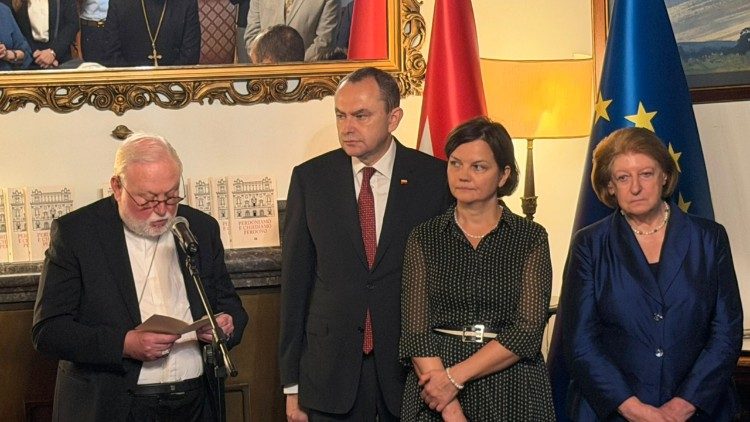
Archbishop Gallagher: Reconciliation is born of accepting truth about past
Reconciliation is born not from forgetting the past, but from the ability to face it truthfully, with courage and trust, while opening ourselves to sincere dialogue.
Archbishop Paul Richard Gallagher, Secretary for Relations with States and International Organizations, said at the Polish Embassy to the Holy See during the presentation of a publication on Polish-German reconciliation after the Second World War.
Entitled “We Forgive and Ask for Forgiveness,” the publication takes its title from the historic message addressed by the Polish Bishops to the German Bishops in 1965.
It is the fruit of an academic conference held last year at the Pontifical Gregorian University to mark the 60th anniversary of that unprecedented event.
Archbishop Gallagher attended the presentation and highlighted the contemporary significance of the gesture made by the two episcopates decades ago.
“The words ‘We forgive and ask for forgiveness’, spoken in a Europe still deeply scarred by the wounds of war, retain a particular power and relevance today,” he said. “They remind us that reconciliation is born not from forgetting the past, but from the ability to face it truthfully, with courage and trust, while opening ourselves to sincere dialogue, remembering also that, for a Christian, it is above all a gift from the Lord, as Saint Paul says: ‘In Christ, God reconciled us to himself.’”
The Archbishop stressed that the publication also invites reflection on the value of this witness “for the present and the future, at a time when new divisions and conflicts abound. It reminds us how precious it is to safeguard what has been patiently built over decades.”
He also expressed gratitude to the Polish and German Embassies to the Holy See for their commitment to preserving the memory of an event that made an unprecedented contribution to reconciliation in post-war Europe.
